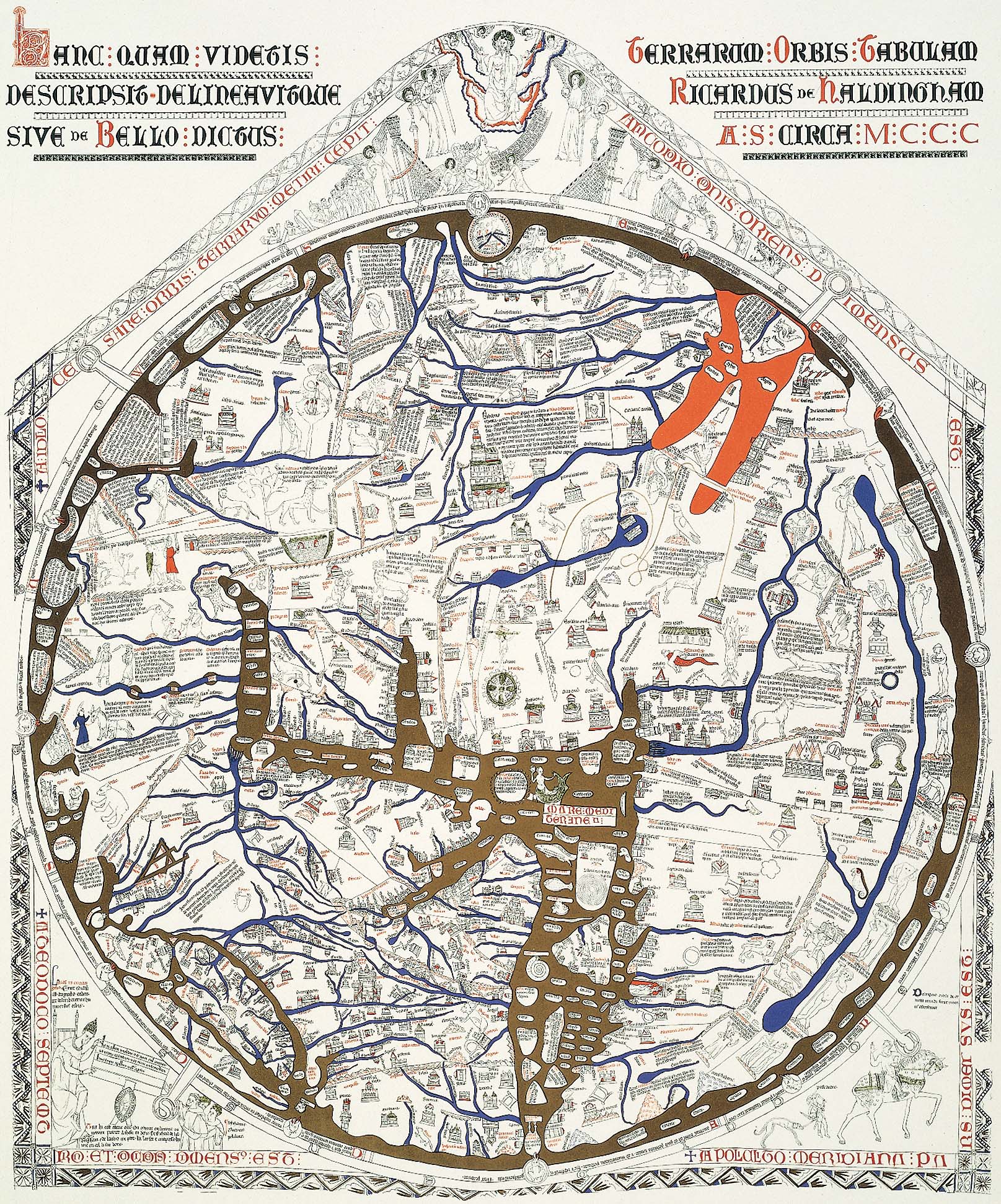
First look at this:
Mappa Mundi
Then look at this:
Garden of Earthly Delights
If you're not noticing similarities, allow me to enlighten you. The first, the Mappa Mundi of Hereford Cathedral is one of the largest and oldest maps of its kind. It is a depiction of world events, history and religion. While it is loosely based on the actual geography of the world, its significance is that it helps us look through the eyes of its creators to see how they viewed the world. 700 years ago we saw the world quite differently and it was always viewed through religious lenses. The map itself depicts events from the Bible, and is headed by Christ as God, and framed with other Judea-Christian references.
The second is a painting from Dutch artist Hieronymus Bosch. You can look him up if you're curious about him, but sufficed to say he was a master of detail and visual menageries. A great many of his works have to do with religion, and events from the Bible.
It's worth imagining yourself back in time, back when the entirety of the world was the land that was visible to you. Rivers were barriers placed by the gods to keep us corralled onto land. The entirety of the world was cordoned off by water. The far shores were lands of legend and myth. They were the playgrounds of the gods and other fantastic beasts. The further you got from home, the more fantastic and dangerous the world became. As man set out across these rivers into new lands they discovered there were no gods residing there. Perhaps there were species of plants and animals that were foreign to them, but nothing else.
As time went on and we became accustomed to our new land we approached great deserts and oceans. Vast, endless expanses. There was no longer a question as to what lay on the other side, for it was believed these were the homes of the sun and moon. The sun would set in the ocean, temporarily extinguished. It would rise from the desert refueled, fiery and warm. The world was flat, the gods resided in the heavens above. Man could swim and float, but he could not fly. Birds were revered as messengers from the gods for they could traverse the distance between land and sky. Owls and eagles became religious symbols, as did flying dragons in some cultures.
Maps from this time began to depict the world as a little broader, yet still surrounded by water on all sides. Great beasts loomed in the depths ready to devour and destroy any ships that wandered too far out.
Eventually man summoned up the courage to explore these waters for months on end. Eventually we discovered new continents inhabited by strange creatures, plants and people. These became the worlds at lands end. They were alien and fantastic. Imagine the first traveler to spot a kangaroo or an ostrich. They must have thought these creatures to be very bizarre.
As the world expanded and maps became more precise with the aid of science religion was slowly squeezed off the canvas. We circumnavigated our planet and came to understand there was no distant shore with golden gates and gods upon it. The sky became less fantastic as we realized that birds were mere animals. We entered an age of understanding where things needed to be measured, calculated and tangible. The gods lost their sway, and soon became symbols and beliefs rather than beings of actual concrete qualities.
When we launched into space and saw our world from above and found that there were no gods in the heavens above, we began to feel small and insignificant. We wondered about life on other planets. We began to map the surface of the moon, of Mars and wherever else we pointed our telescopes. We looked for signs that we were not alone. What was once the river that confined us to our homes was now that black ink of space that teased us. We could look out at everything, the entirety of space. The night sky showed us everything, and yet told us nothing. It's understandable why religion is under more scrutiny these past few centuries than it ever has been before. As we map our place in the universe, we start to run out of places for the gods to hide.
Looking back at the Mappa Mundi of Hereford and the Garden of Earthly Delights it's fascinating to imagine a world where concepts of religion were not warnings or theory. They were directly integral to the construction of our world, however small it may be. In the centre of the Mappa Mundi of Hereford is Jerusalem, and just above it is the depiction of Christ on the cross. 700 years ago religion was the topographical and geographical centre of the world, nay of the entire universe.
These days the things we find religion at the centre of is; debate, discourse, disagreement, debauchery, decadence, dependence, dynamism and devotion.



What sucks, in my opinion, is people who think that the things we've discovered about the physical world and space are evidence enough that there must be nothing that exists outside our understanding. If it isn't in the physical world, it can't possibly be real. It's a shame though, if anything does exist outside physics, in an immaterial way, these people will never know about it.
ReplyDeleteWhich chapter was this, and what was the textbook's title? Kind of an intellectual diatribe. (another 'd') Good alliteration, by the way. Perhaps the higher power has always, and eternally will, resided inside the human entity...spiritually dynamic, don't you think!
ReplyDelete